You can identify a plant from a photo by capturing a clear image of its leaves, flowers, fruit, stems, or other distinctive features and comparing them with possible plant species. A photo-based plant identifier can make this process faster by analyzing visible characteristics and suggesting likely matches.
Already have a picture? Upload a clear image to our Free Plant Identifier to find possible matches, then compare the result with the plant’s visible features.
How to Identify a Plant From a Photo
Plant identification works best when your picture contains enough detail to distinguish one species from another. Follow these simple steps.
1. Take a Clear Photo
Start with a sharp, well-lit picture. Natural or even lighting can make details such as leaf shape, leaf margins, veins, flowers, and stem structure easier to see.
If possible, take one picture of the whole plant and another close-up of its most distinctive feature. Avoid blurry photos, heavy shadows, filters, or several overlapping plants.
2. Photograph Distinctive Plant Features
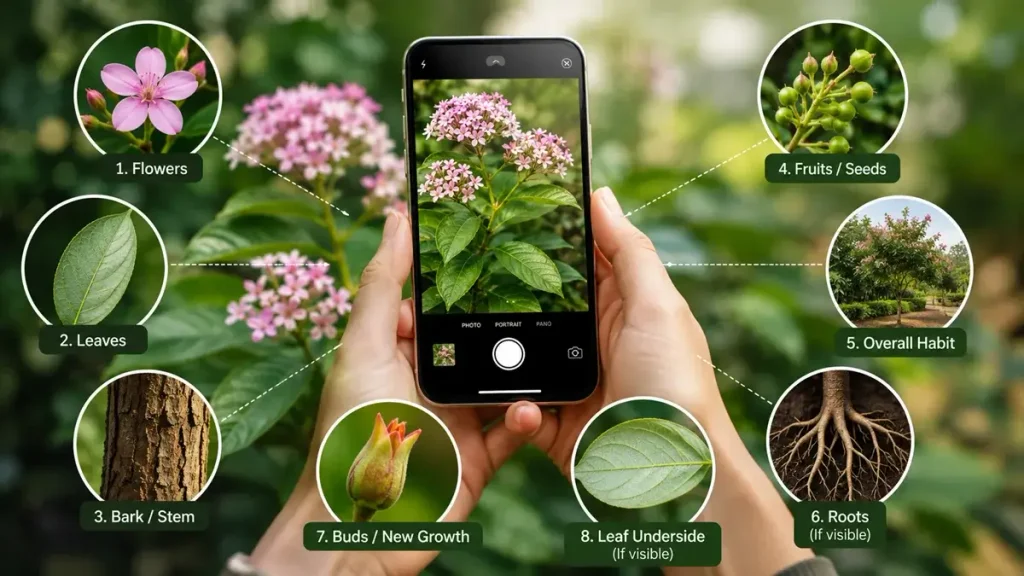
Leaves are often a useful starting point, but they are not the only feature that matters. Photograph any flowers, fruit, seeds, stems, bark, thorns, or buds that are available.
A whole-plant photo can also show the growth habit the plant’s overall form and how it grows, such as upright, trailing, climbing, or spreading.
3. Upload the Photo to a Plant Identifier
Choose your clearest image and upload it to the Free Plant Identifier. The tool can analyze visible characteristics and suggest possible matches.
Review the results rather than assuming the first suggestion is automatically correct. If available, check both the common name and scientific name of the suggested plant.
4. Compare and Confirm the Result
Compare the suggested species with the actual plant. Check its leaves, flowers, fruit, stem, bark, and overall growth form.
Location and habitat can provide additional clues. A plant found in a garden, woodland, wet area, or indoor pot may have different likely matches.
If important characteristics do not agree, try another suggested species or upload a photo showing a different part of the plant.
What Plant Features Should You Photograph?
Different plant parts provide different identification clues. When possible, photograph more than one feature.
Leaves
For leaf identification, look closely at the leaf’s shape, size, texture, veins, edges, and arrangement on the stem.
The leaf margin is the outer edge of the leaf. It may be smooth, toothed, serrated, or lobed. Venation is the pattern formed by the veins running through the leaf. Both can help distinguish similar-looking plants.
If the leaf is the clearest feature you have, try our Leaf Identifier.
Flowers
Flowers can provide useful clues through their shape, petals, color, size, and arrangement. Take a close-up that clearly shows the flower rather than relying on color alone.
If flowers are the plant’s most distinctive feature, use the Flower Identifier to check possible matches.
Fruit, Seeds, Stems, and Bark
Fruit, berries, pods, cones, and seeds can help narrow down a species when leaves look similar. You can also use the Seed Identifier when a seed is the main feature available.
For trees and woody plants, photograph the leaves, branching pattern, and bark. Bark texture and appearance can provide additional clues, especially when combined with a whole-tree photo. Our Tree Identifier can help with these plants.
How to Take a Good Photo for Plant Identification
Better photos give a plant identification tool more useful visual information to work with.
For the best results:
- Keep the plant in sharp focus.
- Use natural or even lighting.
- Take a photo of the whole plant.
- Add close-ups of leaves, flowers, or fruit.
- Show leaves while they are attached to the stem.
- Photograph multiple angles when useful.
- Keep the background simple.
- Avoid filters, glare, heavy shadows, and motion blur.
If you only take one close-up, useful context may be missing. A whole-plant picture combined with a detailed photo of a leaf, flower, fruit, or stem can provide more information for identification.
See our guide on How to Take a Good Photo for Plant Identification for more tips.
Which Part of a Plant Is Best for Identification?
There is no single feature that works best for every plant species. The most useful part depends on what is distinctive and visible.
| Plant Part | Useful Identification Clues |
| Leaf | Shape, margin, veins, texture, arrangement |
| Flower | Shape, petals, color, structure |
| Fruit or seed | Shape, pods, berries, cones, seed features |
| Stem | Nodes, texture, thorns, leaf attachment |
| Bark | Texture, pattern, appearance |
| Whole plant | Size, branching, form, growth habit |
Combining several characteristics is generally more useful than relying on a single feature.
Can You Identify a Plant From a Leaf Photo?
Yes, you can sometimes identify a plant by its leaves, especially when they have distinctive characteristics. Look at the leaf shape, margin, vein pattern, texture, size, and arrangement.
However, different species can have similar leaves. A leaf photo may therefore provide several possible matches instead of one clear identification.
If that happens, photograph a flower, fruit, stem, bark, or the entire plant. These additional features can help distinguish between similar species and plant lookalikes.
How to Confirm a Plant Identification
Treat the result from a photo identifier as a likely match, not automatic confirmation.
Compare several characteristics:
- Do the leaf shape, edges, and veins match?
- Are the leaves arranged the same way on the stem?
- Do the flowers or fruit look similar?
- Does the stem or bark match?
- Is the plant’s growth habit similar?
- Does the location or habitat make sense for that species?
A match supported by several visible characteristics is more convincing than one based only on color or general appearance.
If you are identifying a plant because you intend to eat it, use it medicinally, or make another safety-sensitive decision, do not rely only on photo identification. Seek appropriate expert confirmation.
Why a Plant May Be Difficult to Identify From a Photo
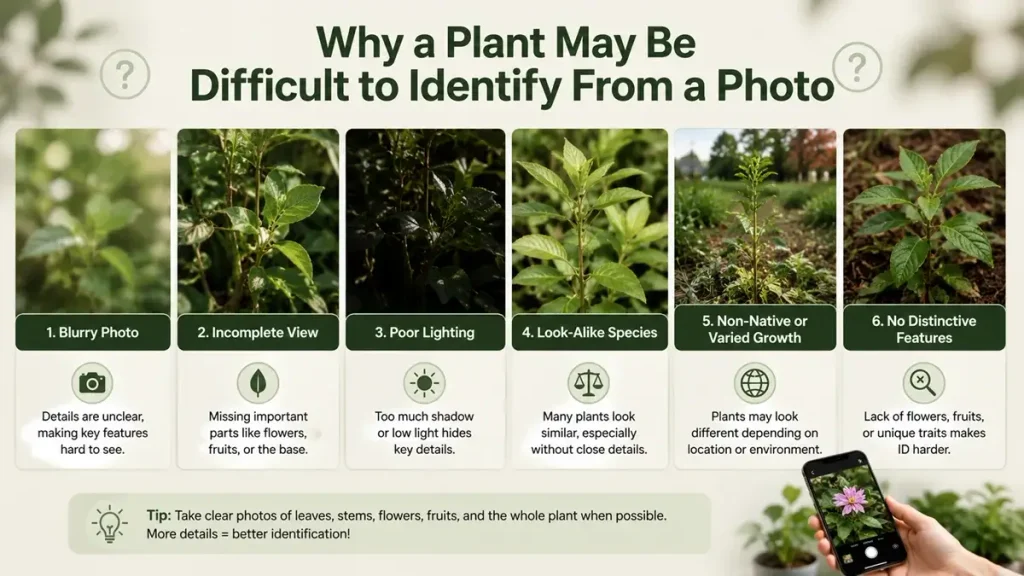
An unknown plant may be difficult to identify when the picture does not show enough distinctive information.
Common problems include:
- A blurry or dark image
- A distant photo
- Damaged leaves
- No flowers or fruit
- A very young plant
- Multiple plants overlapping
- Closely related species with similar features
- Cultivars or hybrids with different appearances
If your first attempt is uncertain, take another photo instead of repeatedly uploading the same image. Show a different plant part or capture the whole plant for additional context.
Common Mistakes When Identifying Plants From Photos
Do not rely only on flower or leaf color. Lighting, plant age, and natural variation can affect how colors appear in a picture.
Another common mistake is accepting the first suggested species without checking its characteristics. Compare leaves, flowers, fruit, stems, and growth habit before deciding on a match.
Also avoid blurry images, heavy filters, damaged plant parts, and photos containing several overlapping plants.
What to Do If You Still Can’t Identify the Plant
If you still cannot identify the plant, take a clearer whole-plant photo and close-ups of different features. Try to include an undamaged leaf attached to the stem, plus flowers, fruit, seeds, or bark when available.
Upload the clearest image to the Free Plant Identifier and compare the likely matches carefully. If reliable species-level identification is important, consider getting confirmation from a qualified local plant expert.