
Find Plant Names from Any Leaf
or scan using your device
JPG, PNG, WEBP · Max 10MB
Analyzing seed coat, structural geometry, and plant classification...
Upload a seed photo and discover the plant species, germination details, and growing information within seconds using AI-powered recognition technology.
✅ AI-Powered Seed Recognition
✅ Instant Identification Results
✅ Mobile Friendly
✅ Free Online Tool
✅ Botanical Database Matching
Who This Tool Is For:
Gardeners, farmers, students, botanists, seed collectors, hikers, and plant enthusiasts who want to identify unknown seeds quickly and accurately.
A Seed Identifier is an AI Plant Identifier tool that helps users identify seeds from uploaded photos. The system analyzes visual seed characteristics and compares them against botanical databases to estimate the most likely species match.
The tool evaluates multiple seed traits, including:
Gardeners often use seed recognition tools to identify saved seeds, unknown garden plants, wild species, or seeds collected during farming and outdoor activities.
Step 1 Upload a Clear Seed Photo
Take a close-up image with sharp focus and bright lighting. Plain backgrounds improve recognition accuracy significantly.
Step 2 Capture Multiple Angles
Upload additional images if the seed contains visible ridges, stripes, or unusual surface patterns.
Step 3 Start AI Analysis
Click the “Identify Seed” button to begin image recognition and botanical database matching.
Step 4 Review Identification Results
The tool displays possible seed matches with confidence scores and botanical information.
Step 5 Explore Growing Information
Read germination guidance, watering needs, sunlight requirements, and planting recommendations.
Step 6 Compare Similar Matches
Review alternative suggestions if multiple species appear visually similar.
Step 7 Upload a Better Photo if Needed
Retake the image if the result appears inaccurate or incomplete.
The AI system uses computer vision and machine learning to compare uploaded seed images against trained botanical datasets. Multiple visual characteristics are analyzed simultaneously to estimate the most likely species match.
AI Recognition Process
AI Process | Purpose |
Shape Analysis | Compares overall seed structure |
Texture Recognition | Detects wrinkles, ridges, and coatings |
Color Detection | Identifies dominant colors and patterns |
Pattern Matching | Analyzes spots, stripes, and markings |
Database Comparison | Matches images against seed libraries |
Different seeds contain unique visual features that help distinguish species more accurately.
Feature | Why It Matters |
Shape | Helps separate plant families |
Texture | Identifies seed coat patterns |
Color | Narrows species possibilities |
Size | Improves database matching |
Surface Markings | Detects ridges and stripes |
Symmetry | Helps compare structural similarities |
Common Seed Shapes
Common Seed Textures
What Information the Tool Provides
The identification results may include:
Many users rely on this information to make smarter gardening and planting decisions.
Vegetable Seeds
Flower Seeds
Herb Seeds
Tree & Wild Plant Seeds
Example Scenario
A user uploads a small black oval seed with a glossy surface.
AI Feature Analysis
Feature | Match Score |
Shape Match | 94% |
Texture Match | 91% |
Color Match | 97% |
Pattern Match | 89% |
Size Match | 93% |
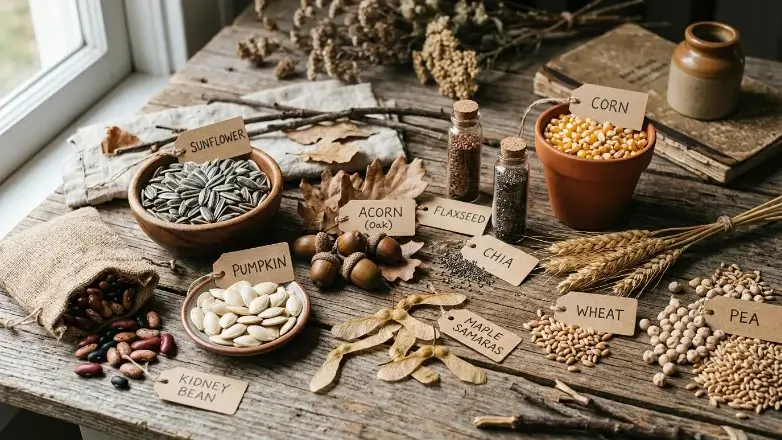
The AI evaluates multiple visual characteristics simultaneously to estimate recognition confidence.
Confidence Score=Shape Match+Texture Match+Color Match+Pattern Match+Size MatchTotal Factors\text{Confidence Score}=\frac{\text{Shape Match}+\text{Texture Match}+\text{Color Match}+\text{Pattern Match}+\text{Size Match}}{\text{Total Factors}}Confidence Score=Total FactorsShape Match+Texture Match+Color Match+Pattern Match+Size Match
Step 1 Add Match Scores
94 + 91 + 97 + 89 + 93 = 464
Step 2 Count Total Factors
5 factors analyzed
Step 3 Calculate Average Score
4645=92.8%\frac{464}{5}=92.8\%5464=92.8%
Final Result
Result | Value |
Identified Seed | Chia Seed |
Scientific Name | Salvia hispanica |
Confidence Score | 92.8% |
Germination Time | 7–14 days |
Sunlight Requirement | Full Sun |
Water Needs | Moderate |
The confidence score estimates how closely the uploaded image matches reference seeds in the database.
Confidence Score | Meaning |
95–100% | Very strong match |
85–94% | Highly likely identification |
70–84% | Possible match |
Below 70% | Lower certainty |
Multiple matches may appear when seeds share similar visual traits.
Accuracy depends heavily on image quality and seed visibility. Clear close-up images usually produce stronger identification confidence.
The AI performs best when:
Rare or damaged seeds may reduce recognition accuracy.
Best Practices
Helpful Tip
Adding a coin or ruler beside the seed may improve size estimation accuracy.
Several common mistakes reduce AI recognition quality.
Mistake | Problem |
Poor Lighting | Hides important details |
Mixed Seed Images | Confuses recognition models |
Blurry Photos | Reduces texture analysis |
Cropped Seeds | Makes shape comparison difficult |
Dirty Seeds | Interferes with classification |
Seed recognition focuses on early-stage plant structures rather than mature leaves or flowers.
Seed Identification | Plant Identification |
Uses texture & shape | Uses leaves & flowers |
Works before germination | Works after plant growth |
Focuses on morphology | Focuses on plant structure |
More difficult visually | Often easier visually |
You may also find these tools helpful:
Faster Identification
AI reduces manual searching through gardening books and online databases.
Beginner-Friendly
New gardeners can identify seeds without advanced botanical knowledge.
Educational Value
Students and researchers can learn seed morphology and plant classification.
Better Gardening Decisions
Correct identification helps improve planting success and crop management.
Seed Collection Organization
Collectors can categorize and manage stored seeds more efficiently.
Thousands of botanical reference images help improve identification quality and consistency. The AI system continuously compares uploaded seed images against trained datasets to provide fast and educational results.
Key trust signals include:
Understanding seed anatomy helps users interpret identification results more accurately.
Seed Coat
The outer protective layer covering the seed.
Embryo
The developing young plant inside the seed.
Cotyledon
The seed leaf storing nutrients for early growth.
Hilum
A visible scar showing where the seed attached to the parent plant.
Different species contain unique combinations of these structures.
Proper storage improves seed lifespan and germination success.
Seed Storage Tips
Germination Tips
Seed viability may decrease when storage conditions remain poor.
AI-generated results may become less accurate under certain conditions.
Damaged Seeds
Broken or immature seeds are harder to classify correctly.
Similar Species
Some plant species produce nearly identical seeds.
Rare Seeds
Extremely uncommon plants may not exist in the training database.
Low-Quality Images
Poor image quality reduces recognition reliability.
Mixed Seed Collections
Multiple species in one image may generate conflicting results.
Professional verification is recommended when:
AI-generated results should support learning and gardening guidance rather than replace professional botanical analysis.
The identification system uses AI-powered image recognition, seed morphology analysis, and botanical reference databases to compare uploaded seed images against known plant species.
Results are provided for educational and informational purposes only. Consult a qualified botanist, horticulturist, or agricultural professional when identification accuracy is critical.
A Seed Identifier is an AI-powered tool that recognizes seeds from uploaded photos by comparing visual features against botanical databases.
The AI analyzes seed shape, texture, color, patterns, and structure before matching the image with trained recognition models.
Yes, users can upload seed photos and receive AI-generated identification results online for free.
Clear photos with strong lighting usually improve accuracy. Damaged or blurry seed images may reduce confidence scores.
Yes, many common vegetable seeds can be recognized, including tomato, cucumber, pumpkin, and pepper seeds.
Yes, the AI can recognize many flower seed species based on visual texture, shape, and structural patterns.
AI-generated results are helpful for learning and gardening guidance, but professional verification is recommended for scientific or commercial use.
Free Plants Identifier helps you identify plants instantly using advanced tools and guides. Learn about plants, care tips, and nature easily in one place.
© 2026 Free Plants Identifier. All Rights Reserved.